

On the night of the count I said that the work starts now. One hundred days on, this is my account of it:
what I have been asked to sort out, what I have got moving, what I have not yet cracked, and what I
intend to do over the next 6 months. I am the only Labour councillor on the Isle of Wight Council, which means I do not get to hide in a group. It also means that when something needs saying
about Cowes North, I have to say it myself. That suits me.
Cowes has just come through the bicentenary Cowes Week – two hundred years of the regatta, and a town that showed the world exactly what it can do. It matters commercially as well as culturally as for a lot of the town’s businesses, the season pays for the winter. The job the rest of the year is to make sure the town works just as well for the people who live here in February.
I am writing this the morning after an Emergency Alert went to every phone in the country warning people not to light fires. On an Island that watched Headon Warren burn last month, that is not an abstract announcement, and it leaves us a clear job to finish locally.
Your Casework
The bulk of this job is not committee meetings. It is drains, bins, potholes, parking, housing, benefits, blue badges, overgrown hedges, planning, and people who have been passed between departments until they gave up.
In my first 100 days:
I have dealt with over 50 separate cases/issues from residents. They have been quite varied, but the main themes have included:
- Roads, parking and highways;
- Anti-social behaviour and other concerns affecting people where they live;
- Waste collection, bins and environmental issues.
Plenty of it sits outside those headings. Cowes Week brought its own postbag, as it does every year, and so did questions about events and operations at Northwood House. I want to be clear about I approach these types of issues as Cowes Week and our events season are a huge part of why this town works as they fill the pubs, shops, cafes, B&Bs and chandlers, they support jobs that last all year, and the bicentenary showed Cowes at its very best.
Northwood House is a genuine asset and has to earn its keep to survive. So my job is not to take sides between residents and events, it’s to make sure the people who live closest to them are listened to on the practical stuff like noise, parking, access, litter, and clearing up afterwards so that events remain welcome in our town. If we get that right then everybody wins, including the businesses that depend on them.
If something in your street is not right, please tell me. I would far rather hear about it early than read about it later.
A number, a date and a name When County Hall tells me something is “in hand”, I ask for three things; a number, a date and a name. How much, by when, and who is accountable. Until I have all three, I do not count it as done, and I will not tell you it is done either.
Mill Hill Road
What residents told me:
Their case is about the condition of the whole stretch between the Victoria Road junction and the Newport Road junction. The surface has become extremely uneven, with deep hollows, potholes, and previous patch repairs that keep breaking up. A particular worry is the vibration when heavy vehicles travel over it as residents say it is felt inside properties on both sides of the road and causes considerable disturbance. Several also raised what that continuing vibration and poor surface might mean for the water, sewer and other utilities running underneath, which is a question only a proper technical assessment can answer.
Their position is straightforward, and I agree with it as repeated patching is not solving the problem. They want the full stretch assessed and edge-to-edge resurfacing programmed, rather than another round of temporary repairs.
What I have agreed to do next:
I have taken ownership of pursuing this on their behalf. I am writing directly to the senior officers responsible for highways at the council and the the chief executive of Island Roads, asking for a proper assessment of the condition of the whole stretch, a record of what maintenance has already been carried out, an explanation of why repeated repairs are not lasting, and whether full reservicing can be programmed. I want a clear answer on what happens next, and by when – a number, a date and a name.
If you live on or near Mill Hill Road and could not make the meeting, please get in touch and I will add your account to the case. Evidence from residents is what moves a road up the list. One complaint is an opinion, twenty is a pattern.
The Floating Bridge
This was one of the big issues on the doorstep, and it has not gone away.
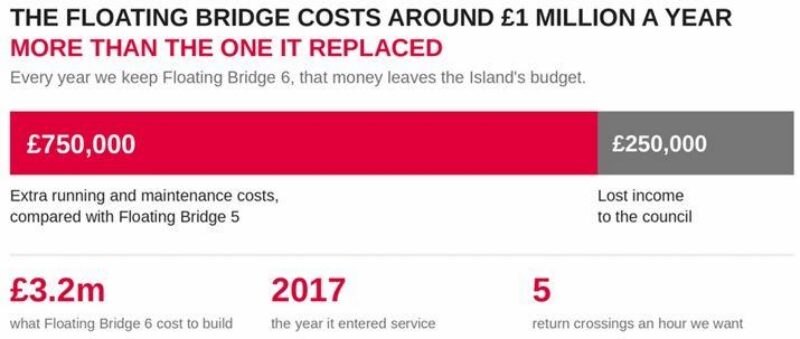
Floating Bridge 6 costs roughly £750,000 a year more to run than Floating Bridge 5 did, and it brings in around £250,000 a year less. That is about £1 million a year, and that’s money that could be paying for roads, or care, or SEND places, and it will go on costing that for as long as the vessel stays in service. A crossing that once made money for the council now loses it.
Availability figures do not tell the story either. A service that is 95% available still misses one crossing in twenty, and if the crossings are infrequent to begin with, people simply stop relying on it and drive round through Newport instead. Businesses on both sides of the river have felt that.
Where things stand:
The council resolved in October 2025 to go to the market for the replacement, and marine advisers were appointed to test market interest earlier this year. A working group of councillors, officers, both town councils and the harbourmaster is now meeting on it.
What I have been pushing for:
- Publication of the operating accounts for the Floating Bridge 6 alongside Floating Bridge 5, so residents can see the £1 million a year for themselves rather than take anyone’s word for it. I have asked for this formally as a written members question.
- The invest to save case is put in writing to the Leader of the Council and the chair of the Policy, Finance and Resources committee; the cheapest option over the next twenty years is not the one with the smallest price tag today.
- A specification that holds; at least five return crossings an hour, throughout the day and evening, whatever the tide is doing.
One thing I will not do is put made up numbers in front of you. If anyone tells you a new floating bridge means hundreds of pounds on your council tax bill, ask them to show you the working, including the sale of the current vessel and the settlement money.
Sewage In The Medina
Within days of my being elected, we had two serious failures on the network. On 12th May a burst sewer put sewage into gardens on Old Road in East Cowes and tore up the surface of Millfield Avenue. Four days later a power failure at Southern Water’s Cowes High Street pumping station, between 2.19 am and 3.55am, led to a discharge and a fresh Environment Agency warning against going in the water off Cowes and East Cowes.
I put the warning out to residents that morning because families needed to know before children, swimmers and paddleboarders got in the water. Southern Water say the release itself last three minutes. What I want to know is why the outage happened at all, and what has changed since.
What I have done and am doing:
- I’ve gone through the Environment Agency’s public register to establish exactly which storm overflow sites in the Medina catchment are involved, and what their compliance record actually is. I want verified data, not estimates.
- I immediately wrote to the Environment Agency and taken the case directly to Southern Water’s chief executive, meeting him a few weeks later and I will keep going back until we get a number, a date and a name against each site.
- Working with Richard Quigley MP, who has raised this at national level, and with councillors from other groups where we agree, including on the East Cowes side of the river, where residents have had the worst of it.
- I have also prepared a council motion on the discharges into the Medina. The Island cannot keep being a place where this is treated as normal.
ROADWORKS: “IS THIS AS GOOD AS IT GETS?”
At the transport committee on 23rd July I asked Island Roads what had gone wrong. From the public’s point of view it looks like chaos out there, and people are entitled to know whether this is the next five years or just a bad patch.
The numbers put to the committee were striking: more than 12,000 applications to dig up Island roads in 2025/26, that’s around a thousand a month, with 7,934 permits granted. The council’s strategic director accepted that it has to improve and that utility companies have to be held to account. I intend to hold him to that, and to come back to the same committee with the figures to check.
If a set of works in Cowes North is badly signed, overrunning or blocking access for someone who cannot easily get around it, tell me. You can also report faults directly at https://fms.islandroads.com/
FIRE, DROUGHT AND OUR OPEN SPACES
If your phone went off last night, that was the Emergency Alert. The Government sent it to every phone in England and Wales, warning people not to light anything that could start a fire, so barbecues, campfires and fireworks, and to call 999 immediately if they see one. It is the most extensive use of the alert system ever made in response to an active incident.
It came alongside a serious package of action: an immediate nationwide ban on the sale of disposable barbecues, with retailers told to pull them off the shelves that day; emergency funding for the fire and rescue services under the heaviest pressure; and 200 military personnel deployed to support the response in the worst hit areas. The Prime Minister spent the day with fire hit communities in Stourbridge. Ministers have also announced a national wildfire summit later this year, bringing together fire chiefs, the National Fire Chiefs Council and the Fire Brigades Union, building on £97 million already committed for firefighter training and specialist equipment.
That is a government moving at speed the situation demands, and Islanders should know it is happening.
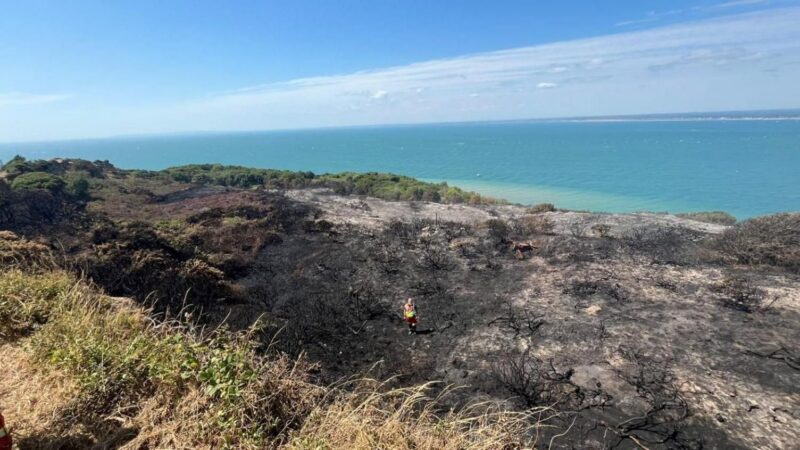
We know why it matters after July’s wildfire at Headon Warren burned through one of the Island’s most important protected landscapes and took a very large emergency response to bring it under control. It’s now known that firefighters found the remains of a campfire which is why Richard Quigley MP’s letter to Island retailers asking them to suspend sales voluntarily, and equally important that several did so before the national ban followed.
What no government can do from Whitehall is decide which particular fields, heaths and headlands on the Isle of Wight need protecting, or when. That part is ours, and it is the part I have been working on since I was elected.
On the 30th July the environment and community protection committee was advised by officers that there is not currently the funding, capacity or evidence base to bring restrictions on council owned land. I understand the pressure officers are under and I said so at the time. But “not now” should not mean “nothing” and there is plenty we can do that costs very little which I said in my note to councillors, and importantly now the ground has shifted since that meeting.
The Secretary of State is now writing to every council in England, reminding us of the power we already hold to restrict activities that increase fire risk, and naming Public Spaces Protection Orders (PSPOs), to limit barbecues, campfires and open fires in vulnerable areas as one of them. That is the same tool the July report put aside and which I have challenged. When the responsible government department writes out to councils pointing at existing powers, the question in September’s council meeting is no longer whether we may act, but how quickly and how carefully we do.
So when the report comes back next month, I will be asking four things:
- A narrow, seasonal order covering the handful of key Island sites that are at risk of burning, rather than an unenforceable Island wide ban;
- The Secretary of State’s letter placed in front of members, and the report written against it;
- The real cost of the Headon Warren response from Hampshire and Isle of Wight Fire and Rescue, together with an answer of the funding scheme, which ministers have confirmed is available for exceptional wildfire recovery costs, applies to any of it as prevention can only be weighed against affordability once we know what a single day’s wildfire actually costs the public purse;
- A clear local trigger and I would suggest that is the Met Office Fire Severity Index, so that our request to retailers and campsites, and any regional restrictions switches on automatically rather than depend on someone’s diary.
The rain will come eventually, and with it the temptation to shelve all of this until next summer. I do not intend to let that happen, because the next Headon Warren is prevented in the quiet months, not the hot ones.
(Note: This is correct as at Saturday 15th August, 2026).
CROSS-SOLENT FARES
From July, the Emissions Trading Scheme applies to cross-Solent ferries, and operators have begun adding a separate charge of up to £3.50 on a return crossing. Scottish island routes have an exemption until 2030 and Northern Ireland routes get a fifty per cent reduction. The Isle of Wight get neither.
I support cleaner ferries. But you cannot electrify a fleet without the grid capacity to charge it, and the Island does not have it. Charging Islanders for a choice they have not been given the means to make is not an environmental policy, is a tax on living here. I am working with Richard Quigley MP, who has taken this to the Prime Minister and to ministers directly, to get the island treated like every other island.
WHERE I SIT, AND WHY IT MATTERS
I sit on four committees, chosen deliberately so that issues that matter to Cowes North have someone in the room:
- Economy, Regeneration, Transport and Infrastructure
-
- The Floating Bridge, roads, roadworks, buses and the transport plan.
-
- Policy, Finance and Resources
-
- The council’s money – where the budget goes and what gets cut.
-
- Environment and Community Protection
-
- Wildfire prevention, waste, water quality and public protection.
-
- Harbours
-
- The working river and the harbour that Cowes depends on.
-
I am also still a Cowes town councillor. That is useful as a lot of what actually gets delivered in Cowes gets delivered at town level.
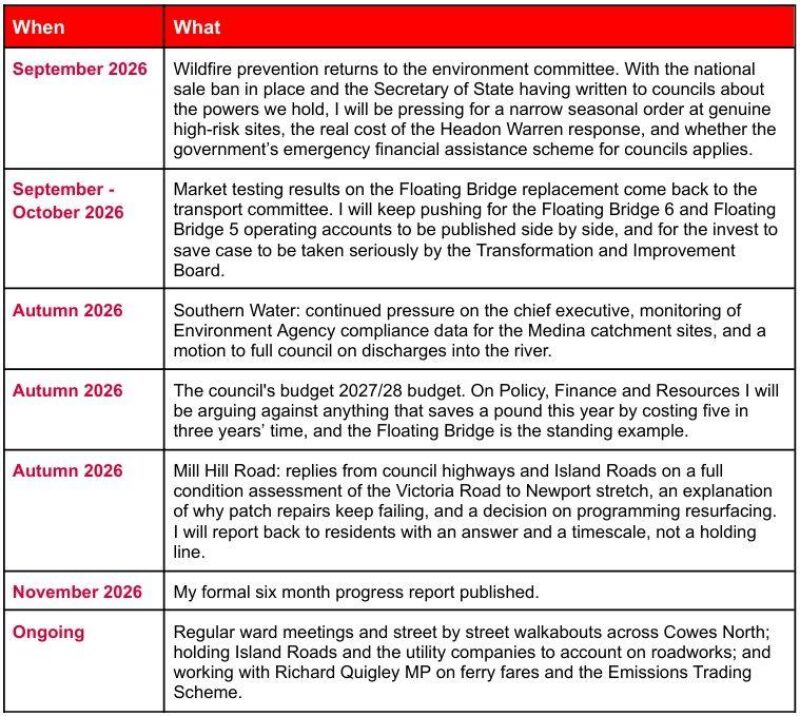
THE NEXT SIX MONTHS
Here is what I am working on between now and February. I will report back against this list, including the bits I do not manage to make progress on.
HOW TO GET HOLD OF ME
I would rather hear from you early than late. No issue is too small to mention, and if it’s not something the council can fix I will tell you that honestly and point you at whoever can.
https://www.facebook.com/messages/t/61573288049072/
Report a road or pavement fault directly:
Report a pollution incident to Southern Water and the Environment Agency. Please copy me in, so I can add it to the record we are building for the Medina:
https://www.gov.uk/report-water-pollution
https://www.southernwater.co.uk/help-and-support/report-a-pollution/